Ten Thousand Forgettable Miles
Nine months and the slow realisation that I bought into hype instead of a car — the story of my BMW M3 Competition xDrive and ten thousand forgettable miles.
Nine months, two cars, and the slow realisation that I bought into hype instead of a car.
I bought the M3 because everyone told me to.
Not directly. Nobody sat me down. But I had spent a couple of years inside Supra ownership, and there is a well-worn path out of it — you watch owner after owner arrive at the M3 or the M4 like it is the natural graduation, the place you go once you are serious. The videos all agree. The forums all agree. The consensus is so total that it stops presenting itself as an opinion.
So I went looking, in the middle of July, for a new one. That turned out to be a damn fantasy. Dealers were not really selling M3s at that point so much as auctioning them — allocations went to whoever blinked slowest on the markup, and the cars that did exist on the ground were mostly specified by nobody in particular. Black over black. White over black. No buckets. The configuration a car ends up with when the person ordering it is not the person who will look at it.
The few good ones behaved like royalty. Prince Charming in frozen paint, courted by men with deeper pockets and warmer relationships with a sales manager, and me somewhere in the crowd being a peasant about it — allowed to look, allowed to want, never once in the running. You can tell yourself you are a serious buyer right up until a dealer explains that serious is a dollar figure and yours is not it.
My rules were not complicated. Not black on the outside, not white. Buckets inside, and not black in there either. Three requirements. They eliminated almost everything.
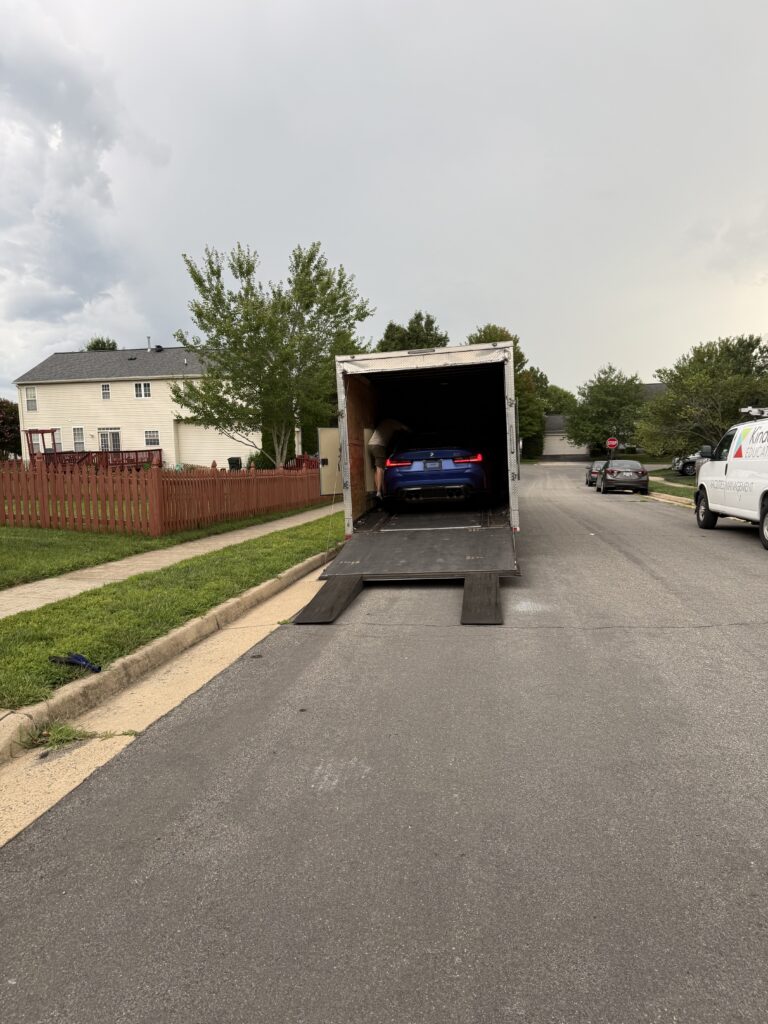
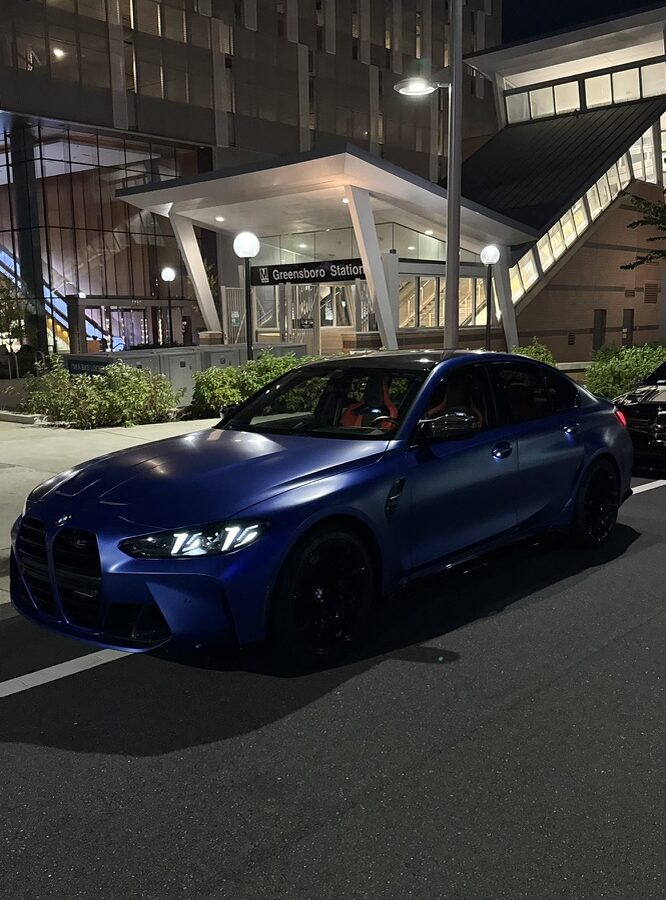
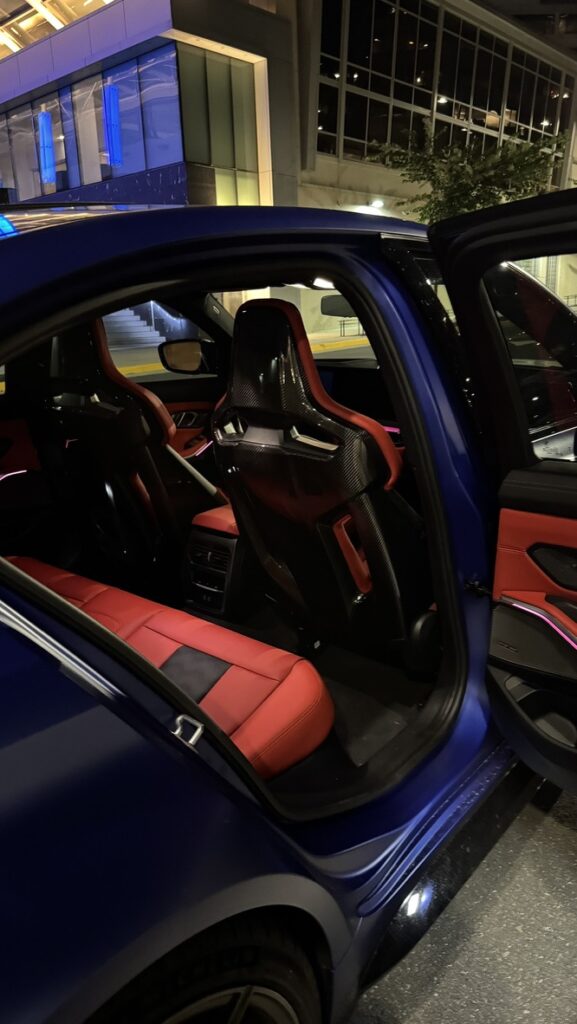
It took until September, and in the end I did not get a new car at all — I settled for a used one with a thousand miles on it, somebody else’s decision, because by then I had stopped caring whether the choices were mine. What that car happened to be was a Competition xDrive in Frozen Portimao Blue over Fiona Red carbon buckets, and I want to be clear that I still believe this is one of the best-looking specifications you can put on a modern BMW. The Individual frozen paint looks dead gorgeous. The red against the exposed weave of the seat shells is the sort of decision a colour department only gets to make a few times a decade.
I will go further and say something the internet will not like: the G80 looks better without the angel eyes. The corona rings were BMW’s signature for twenty years and dropping them was treated as heresy, but the current face is cleaner and more deliberate for their absence. It stopped being a car wearing a logo on its headlights.
And here is the part I have to be honest about, because it explains everything that came after: the difficulty made me want it more. Every week the search failed, the car got more valuable to me. Not more suitable. More valuable. Two months of watching bad specs sell for over sticker did something to my judgement that no test drive could have undone, and by September I was not evaluating a car any more, I was completing a chase. That is not a purchase decision. That is scarcity doing your thinking for you, and I could not see the difference at the time.
I had it nine months. It came to me with a thousand miles and it showed ten thousand at the end, which is not a car sitting under a cover feeling sorry for itself. That is a car in constant use.
In the same nine months, the Supra did roughly fifteen thousand.
Read that again, because it is the whole argument. Over an identical window — same driver, same roads, same winter, one of the two cars fitted with all-wheel drive and a back seat and a boot — the two-seater with the loud exhaust and the lowered springs covered half again as many miles as the car that was supposedly better at everything. And I could not tell you a single thing about the M3’s ten thousand.
I drove it constantly. It commuted. It handled weather. It carried people. It did every job I gave it, competently, for nine months, and it left nothing behind. The Supra’s fifteen thousand I remember individually.
Things the M3 is genuinely better at
I want to do this properly, because the version of this piece where the M3 is a bad car is a lie and everyone can tell.
It is more practical, unambiguously. It has a back seat that adults fit in, a boot that holds a week, and xDrive — which, if I am honest with myself, is the single feature that kept the car in my driveway through a Virginia winter. The visibility is in a different league compared to the Supra. The interior is more spacious, the ambient lighting is a genuinely nice thing to sit inside at night, and the sound system comfortably beats the Supra’s JBL premium setup, which is not a close contest.
And I will defend the carbon buckets against their own reputation. Everyone warns you about them. Everyone tells you about the fixed bolsters and the centre ridge and the ingress. In nine months I never once got out of that car sore. They are better seats than people say and I would order them again.
Here is what is missing from that list: anything to do with driving.
Every advantage I just wrote down is a convenience. Space, visibility, weather capability, speakers, lighting. Those are excellent reasons to own a car. They are not reasons to own a hundred-thousand-dollar M car. You can buy all of them for a third of the money, and the badge on the boot is not what makes the back seat useful.
The weight thing is a myth, and that is the problem
The standard criticism of the current M3 is that it is too heavy and you feel it. I do not think that is true. You genuinely do not feel the weight. BMW has done something remarkable with the damping and the front axle, and the car shrinks around you far more convincingly than four thousand pounds has any right to.
But I have come to think that is the criticism aimed at the wrong target. The problem is not that the M3 feels heavy. It is that it does not feel like anything in particular. The engineering achievement is the removal of sensation — no weight transfer you have to manage, no traction you have to negotiate, no moment where the car asks you a question. xDrive is the purest expression of it. It is a system whose entire purpose is to make the interesting part of driving fast happen without your involvement.
What you get in return is speed. Enormous, immediate, entirely trustworthy speed that you cannot use on a public road and that stops being novel roughly two months in. I never turned that car off and wanted to go again. Not once.
The tech does not save it either. People talk about the M3’s electronics like they are a generation ahead — they are not. The Supra runs essentially the same architecture underneath, and in daily use the two cars feel like siblings, because they are. The M3 gives you more screens to configure the removal of sensation. I could not have told you, without looking, which of my two M buttons was set to what.
Yes, the Supra is modded. That is the argument, not a hole in it
The obvious objection: I am comparing a stock car to a modified one. Fair. So let me put the actual list down.
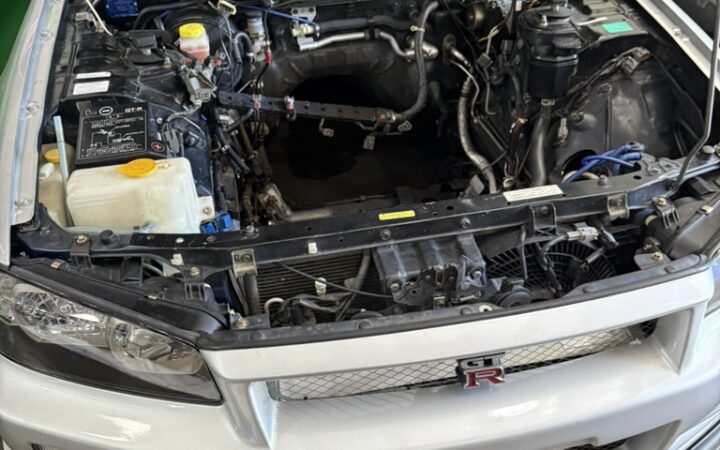
Boost Logic catless downpipe. Valvetronic Designs exhaust, in gold. MHD tune. MST intake. FTP chargepipe. Eibach springs. A Street Hunter–style wing — a replica, and I will say so plainly rather than let someone else point it out — and a carbon front lip.
Now put a number on that. Then put a number on an M3 Competition xDrive with carbon buckets and an Individual paint code. The mods on the Supra do not amount to a rounding error on the difference between those two figures. I could have modified that car three times over and still been tens of thousands ahead.
So the comparison is not stock-versus-modified. It is what a hundred thousand dollars bought versus what a fraction of it bought, and on the only axis I actually care about — do I want to drive this today — the cheap one wins by a distance so wide that the mileage numbers stopped being surprising months ago.
The B58, tuned, in a car five hundred pounds lighter and considerably narrower, does its best work at forty miles an hour in third gear on the way to nowhere. The S58 does its best work somewhere I am not legally allowed to be. On the two-lane roads that actually exist around here, the Supra is the faster car in every sense that matters, and it is having a better time.
So the M3 went
I sold it, and I want to be precise about why, because “I didn’t like it” is not accurate.
I liked it fine. It did everything well. It just did nothing that justified what it cost or the reverence it gets, and the day I admitted that the practicality was the reason I kept it — not the engineering, not the badge, not the M division, the back seats — the decision made itself. A hundred thousand dollars is a lot to spend on a car whose best argument is that it holds four people and copes with snow.
Whoever has it now got a genuinely excellent machine in a specification they will not find again easily. I hope they use the speed more than I did.
I never got the hype. I bought the car to find out whether I would. That was the honest experiment, and the answer came back at ten thousand miles.