What It Really Costs to Own an R34 GT-R V-Spec (Mine’s Been in Pieces for Almost a Year)
Six figures to buy, a car I'd wanted for twenty years — and as I write this, it's apart on a lift with cylinder six gone and the bill still climbing. Here's every number, the honest way.
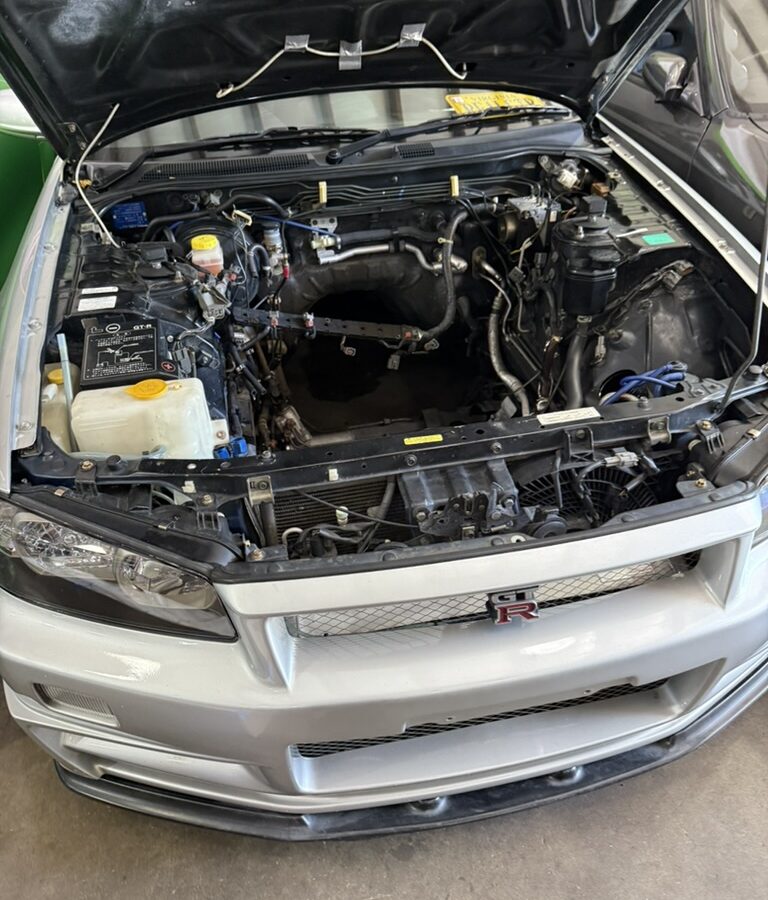
Most stories about owning an R34 GT-R start in a clean garage, car finished, gleaming under the lights. Mine’s on a lift in Virginia. It’s sad, but it is what it is.
Everyone posts the finished car. Nobody shows the building process — so this is the building process.
I wanted this car my whole life: Fast and Furious, the poster on the wall, all of it. But before the GT-R, about a year earlier, I bought a 1998 R34 GTT as my test car. The plan was to flip it for the resale — then I fell in love and kept it. A year after that, the GT-R landed: a V-Spec, track-built, ready to move. It moved for about five months.
Then the white smoke cloud began. We ran a compression test. A healthy cylinder should read north of 150 psi; number six came back at 50. Fully cooked. That was almost a year ago, and the car still isn’t back.
Here’s what the dream has actually cost so far — the numbers I can document, and an honest accounting of the ones I can’t, because the bill isn’t finished. It’s an open tab, and I keep drinking from it.
The figures below come from my own records and reflect my personal experience. Costs vary enormously by car, condition, market timing, insurer, and circumstance. This is informational only and isn’t financial advice — do your own research before making decisions about your own money.
What it actually cost to land one
Honestly? For what it is, the purchase wasn’t that bad. The car was $118,000. Add Japan’s 10% consumption tax and one car becomes about $130,000. Then I touched it up before it ever left — and this part says everything about why I bought it.
This R34 had lived as a track car, stripped of the stuff that makes a car “normal”. So before it shipped, I put it back together as something I could actually drive. Genuine V-Spec rear seats went back in — about $1,000. The driver’s seat was a fixed-back race bucket; I swapped it for a Recaro SR-7 (KK100, Kamui Black) to match the SR-7 the previous owner had already fitted on the passenger side — about $1,400, and now both seats recline. Fresh pre-export maintenance, another $1,000. New front brake pads — $470 for the pads, $400 for the labor.
Then the part everybody forgets to budget for: ocean shipping, the customs broker, US import fees, and getting it from the port to me. That ran about $21,000 on its own. All in, it landed in my driveway at $155,000.
The numbers
| Car (hammer price) | $118,000 |
| Japan consumption tax (10%) | ~$11,800 |
| Genuine V-Spec rear seats | $1,000 |
| Recaro SR-7 driver’s seat | $1,400 |
| Pre-export maintenance | $1,000 |
| Front brake pads (parts + labor) | $870 |
| Shipping, customs, broker & fees | ~$21,000 |
| Landed in my driveway | $155,000 |
Hammer price plus everything it took to make the car street-ready and get it onto US soil
Two things about that number. One: the car is only about three-quarters of it — the tax, the work, and the freight do the rest, and nobody tells you that going in. Two: I got lucky on timing. I bought before the 2025 import tariffs hit, right after the 25-year rule made the ’99 cars legal. A few months later, the same car costs noticeably more.
Insurance: a whole comedy I’ll save for another day
Insuring a car like this is hard — you already know that if you’ve ever tried. I’ll keep the full thing for its own post, because it earns one. The short version: after a real fight with Hagerty, I landed at about $6,000 a year with an agreed value of $175,000 — more than I paid for the car. These appreciate, which is the one line in this whole story that spends in my favor.
The one lesson worth saying now: on a rare import, agreed value is the only number that matters, and you will have to fight for it. A standard policy pays out book value that has nothing to do with what your car is actually worth.
The engine: the lucky one that cooked itself
Here’s the rare part. My car came with a NISMO N1-R — an RB26 with N1 internals, a genuinely special engine. I’m honestly still tracing exactly how this one ended up in my car, and I’m still asking the bigger names in the GT-R world how it got here.
And it’s the engine that died. Cylinder six sent its condolences and took the rest of the car with it. No simple fix — it came fully apart for a rebuild.
I have the machine shop’s invoice, and that’s the only number that actually exists right now: boring and honing, align-honing the mains, decking the block, a complete head recondition, plus forged internals — Wiseco pistons, Eagle rods, ACL bearings. That comes to about $7,000. But that’s just the machine shop. It doesn’t include pulling and reinstalling the engine, any fabrication, any new parts that turn up along the way, or the tune. And the transmission and transfer case are getting done at the same time — no numbers on those yet either.
So I can’t give you a total, because the car doesn’t really exist right now. It’s in pieces. It’s an antique collecting dust in the corner of a shop — a piece of furniture waiting in a dead person’s home.
The numbers
| Agreed insured value | $175,000 |
| Annual insurance (Hagerty) | ~$6,000 |
| Tomei exhaust (DIY install) | $1,200 |
| Engine machine work + forged internals | ~$7,000 |
| Full engine build (labor + tune) | Pending |
| Transmission + transfer case | Pending |
| Back on the road? | Not yet — ~10 months and counting |
If I did it again, I’d change one thing: I’d keep a cheap, throwaway RB26 on hand to drop in and drive while the real N1 got built. Stay mobile, then swap the good motor back in when it’s ready. Live and learn.
The ECU I’m going to rip out
My car came with an HKS F-CON V-Pro. Great piece back in the day — useless to me in Virginia. Almost nobody here has the software to tune it, and I’m not about to ship the car or the ECU across the country every time it needs a change. By the time I paid to do all that, I could just put in a Haltech system.
So that’s the plan: a Haltech, which is what a lot of the fastest cars and cleanest builds run, and which any good tuner can actually work on and dial in exactly how I want. But not yet — first I want the car back. One thing at a time, and the budget isn’t bottomless. The Haltech is on the list; it’s just not at the top of it.
There’s a lesson in that for any import buyer: when you buy a heavily modified car, you inherit someone else’s decisions — and “upgrading” sometimes means modernizing for serviceability, not chasing more power.
What actually surprised me
The road presence is insane. I came from the R34 GTT, and the GT-R just sits there and takes up space — wide, low, planted. The Godzilla name isn’t only about being fast; the thing is physically big, and you feel it next to everything else on the road. The fuel, by the way, is genuinely bad. This is not a car you drive around casually.
Right-hand drive is more fun than scary. Sit in the left lane next to someone in the right and watch them clock that there’s nobody where the steering wheel should be — older folks especially. Their faces are priceless. (My only worry is one of them getting so surprised they drift into me. So far, so good.)
The attention is a lot. Most of it is great — real enthusiasts, good conversations, people who just love the car. Some of it is more than I bargained for, to the point where it gets uncomfortable. I’ll leave it at that.
And the driving itself is a workout. The NISMO Coppermix twin-plate clutch is amazing once you’re moving, but pulling away from a stop — up my driveway, up a hill — is genuinely hard. My left calf was visibly bigger from launching this thing in traffic; I’m not joking. But when you stop babying it, it’s a riot, and that Getrag box is fantastic. I want to add a short shifter eventually, maybe fine-tune the clutch. After the car’s back.
Find your shop before you find the car
The single best piece of advice I have: line up a shop that actually knows this platform before you buy. Mine is Nova Speed Shop in Virginia, and they know these cars well — they’ve been doing RBs and R32s for years, and they’re building another N1 right alongside mine. I trust them with everything: the GT-R, the GTT, my Supra, even my sister’s Mustang. It’s taken a long time. But it’s really good work — and on a car like this, good and slow beats fast and wrong every time.
The bottom line
As I write this, my GT-R has been gone for almost a year. The bill is an open tab, and I keep drinking from it. Some days I think this car wanted my whole life.
I got incredibly lucky to own one — and I drove it for five months, maybe twenty times total, and barely put any miles on it. I genuinely regret that. But it is what it is. Winter softens the blow a little; you don’t drive much in a Virginia winter anyway, with the salt on the road and a carbon undertray I’d rather not destroy. But it’s June now, almost July, and I want my car back so I can actually use it.
When it’s done, it’ll be a better, more dialed car than the one that rolled off the boat. Would I do it again? Yeah. Eyes open — but yeah.
This is an open story, and I’ll keep updating it — the numbers above included — as the bills land and the car finally comes home.
